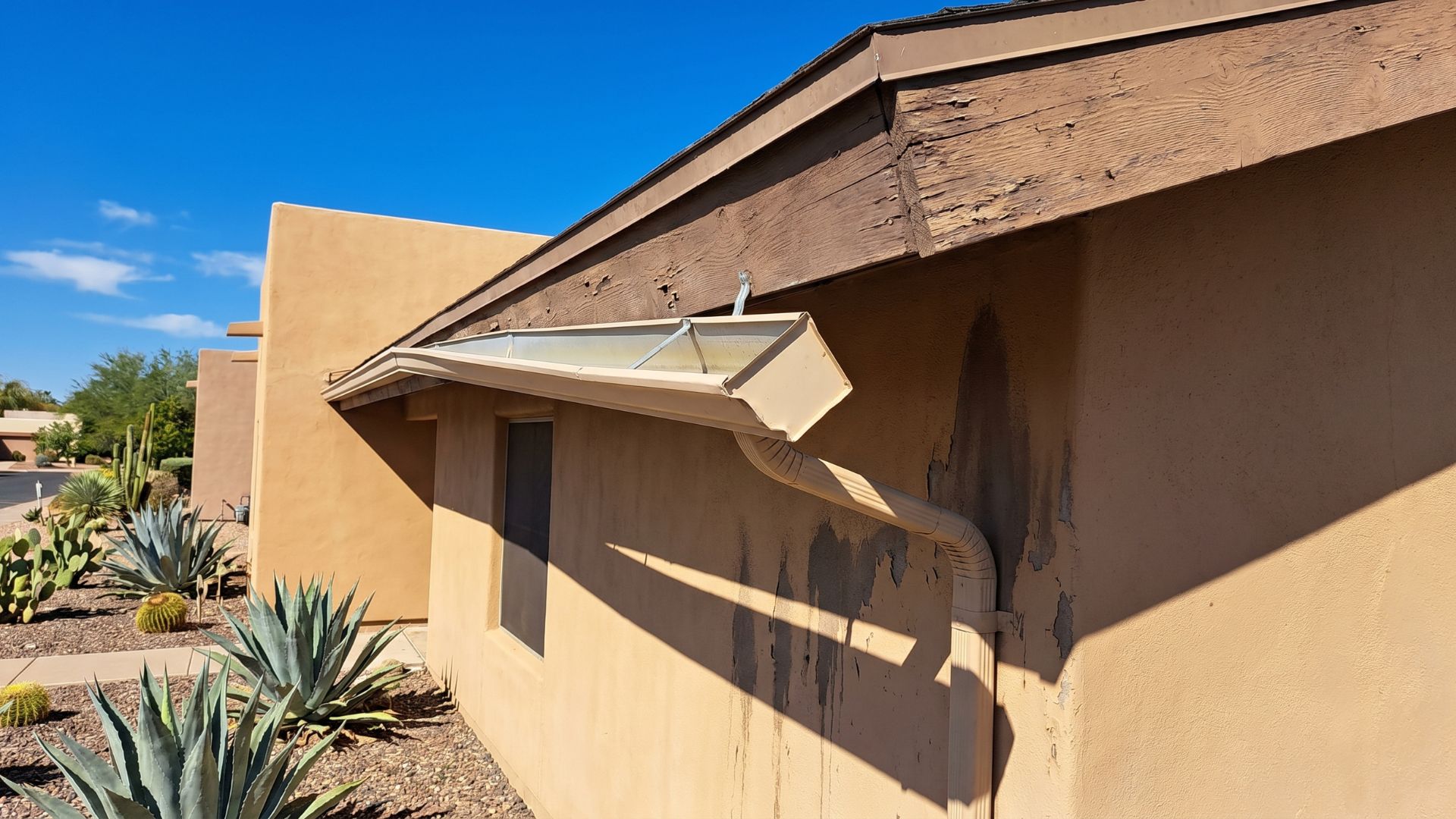
Gutter systems in Phoenix face a unique adversary: intense UV radiation, sudden monsoon deluges, and abrasive wind-blown desert dust. When gutters fail, the consequences cascade quickly—foundation erosion, stucco damage, and landscape washouts. The most telling gutter repair signs in Phoenix include visible separation from the roofline, granular asphalt accumulation from shingle wear, and persistent moisture stains on exterior walls during dry periods. Addressing these indicators before the summer storm season prevents structural repairs that average $4,500 in the Valley, according to local contractor data.
Key Takeaways
- Monsoon-driven debris accumulation is the leading cause of gutter failure in Maricopa County.
- Seam separation at miters and downspout joints signals imminent water intrusion.
- Granular sediment in gutters indicates roof deterioration, not just gutter wear.
- Rust and corrosion accelerate in Phoenix due to hard water mineral deposits.
- Professional inspection twice yearly—before and after monsoon season—prevents 80% of major repairs.
- DIY temporary fixes often mask underlying fascia rot common in stucco-clad Arizona homes.
- Properly sloped gutters are critical; Phoenix’s flat-roof sections demand precise pitch calculations.
1. Visible Sagging or Pulling Away from the Fascia
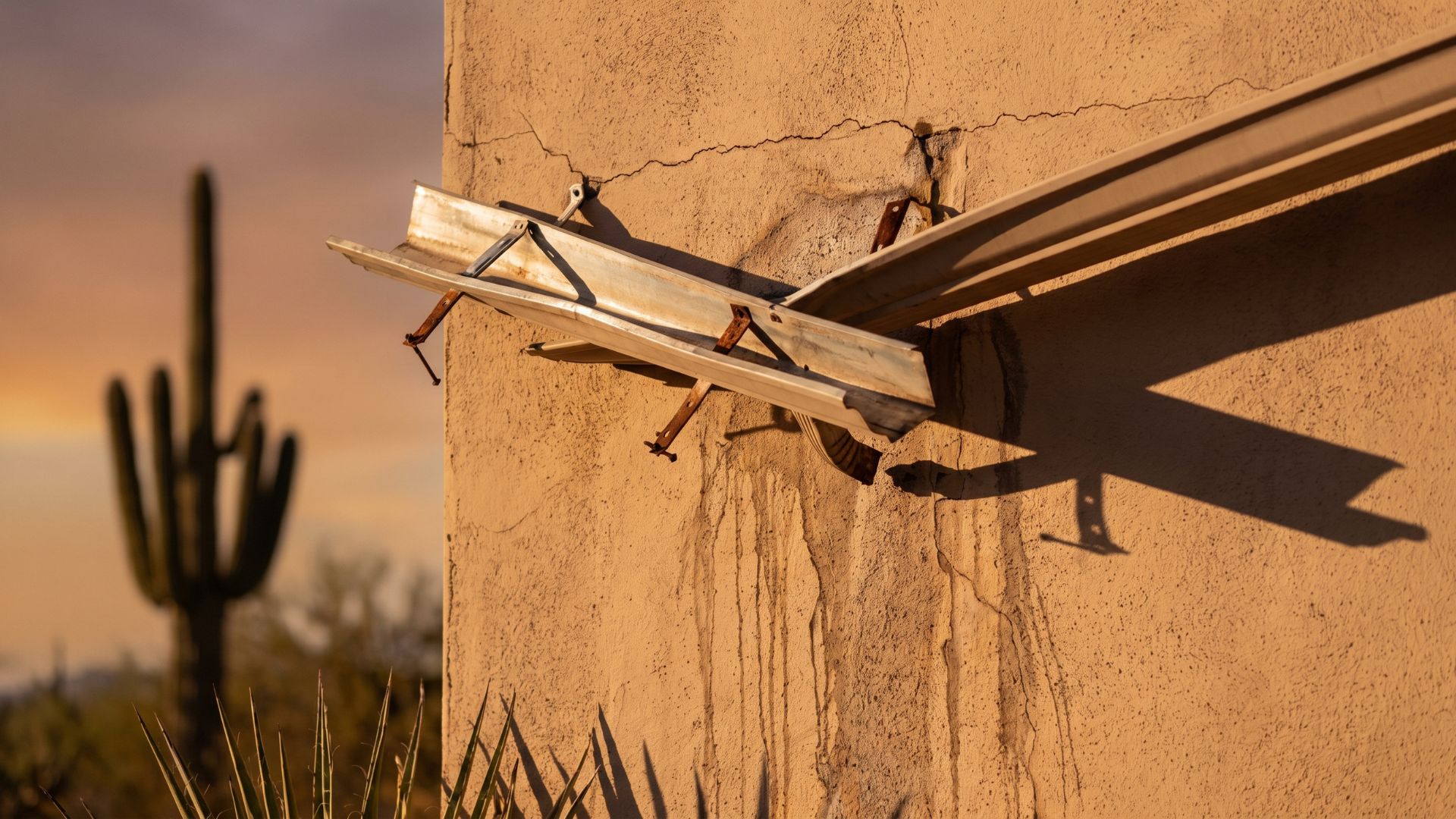
The most unmistakable gutter repair sign in Phoenix is a gutter system that has begun to pull away from the roofline. In Arizona’s climate, the combination of extreme daytime heat and rapid nighttime cooling causes metal components to expand and contract repeatedly. Over time, this thermal cycling loosens the lag screws and ferrules that secure aluminum gutters to the fascia board. When you observe a gap exceeding one-eighth of an inch between the gutter’s back edge and the fascia, water is already bypassing the system during rainfall events. According to the National Association of Home Builders, proper gutter fastening requires hangers spaced no more than 24 inches apart in desert climates to counteract this thermal stress.
Fascia deterioration compounds this problem. Phoenix homes built with wood fascia boards are susceptible to dry rot, which weakens the anchoring point. Even if the gutter hardware remains intact, the substrate fails. A professional assessment involves probing the fascia with an awl to test for sponginess. If the wood yields easily, the repair scope expands beyond gutter reattachment to include fascia replacement. This is particularly common in historic districts like Willo and Encanto, where original 1950s construction materials are reaching end-of-life.
 2. Granular Sediment and Shingle Aggregate in Gutters
Finding coarse, sand-like granules in your gutters is a gutter repair sign that actually originates from your roof. Asphalt shingles shed their protective ceramic granules as they age, and these particles wash directly into the gutter channel. In Phoenix, UV degradation accelerates this process significantly. Research from the Cool Roof Rating Council indicates that rooftop surface temperatures in Phoenix can exceed 160°F during July afternoons, baking the asphalt binder and causing premature granule loss. A thin layer of granules is normal; a quarter-inch accumulation in a single season indicates advanced shingle deterioration.
This sediment creates a compounding problem. The granules add weight to the gutter system, exacerbating sagging. They also trap moisture against the gutter’s interior surface, promoting corrosion in steel components. More critically, granular buildup signals that your roof’s waterproofing layer is compromised. As Sarah Mendoza, Senior Inspector at Desert Shield Home Inspections, explains: “When we see heavy granule deposits in gutters during a Phoenix summer inspection, we immediately recommend a roof assessment. The gutter is acting as an early warning system for a roof that may have less than three years of functional life remaining.”
3. Water Stains or Efflorescence on Exterior Walls
Water stains on stucco or painted exterior walls beneath the gutter line are definitive gutter repair signs in Phoenix. The region’s infrequent but intense rainfall means stains may not appear immediately; they often manifest as white, chalky efflorescence—mineral salts left behind when water evaporates from masonry. This indicates that water is cascading over the gutter’s front lip rather than flowing through the channel. Common causes include improper pitch, clogged downspouts, or undersized gutters that cannot handle monsoon-volume runoff.
Efflorescence is not merely cosmetic. It signals moisture intrusion into the wall assembly. In Phoenix’s frame-stucco construction, repeated wetting can lead to mold growth within wall cavities and corrosion of metal lath. The International Association of Certified Home Inspectors notes that efflorescence on exterior walls should be investigated within 30 days of appearance to prevent structural degradation. A simple test involves running a garden hose onto the roof section above the stain and observing water flow during a simulated rainfall. If water spills over the gutter edge at any point, the system requires re-pitching or upsizing.
4. Separated Miter Joints and Downspout Connections
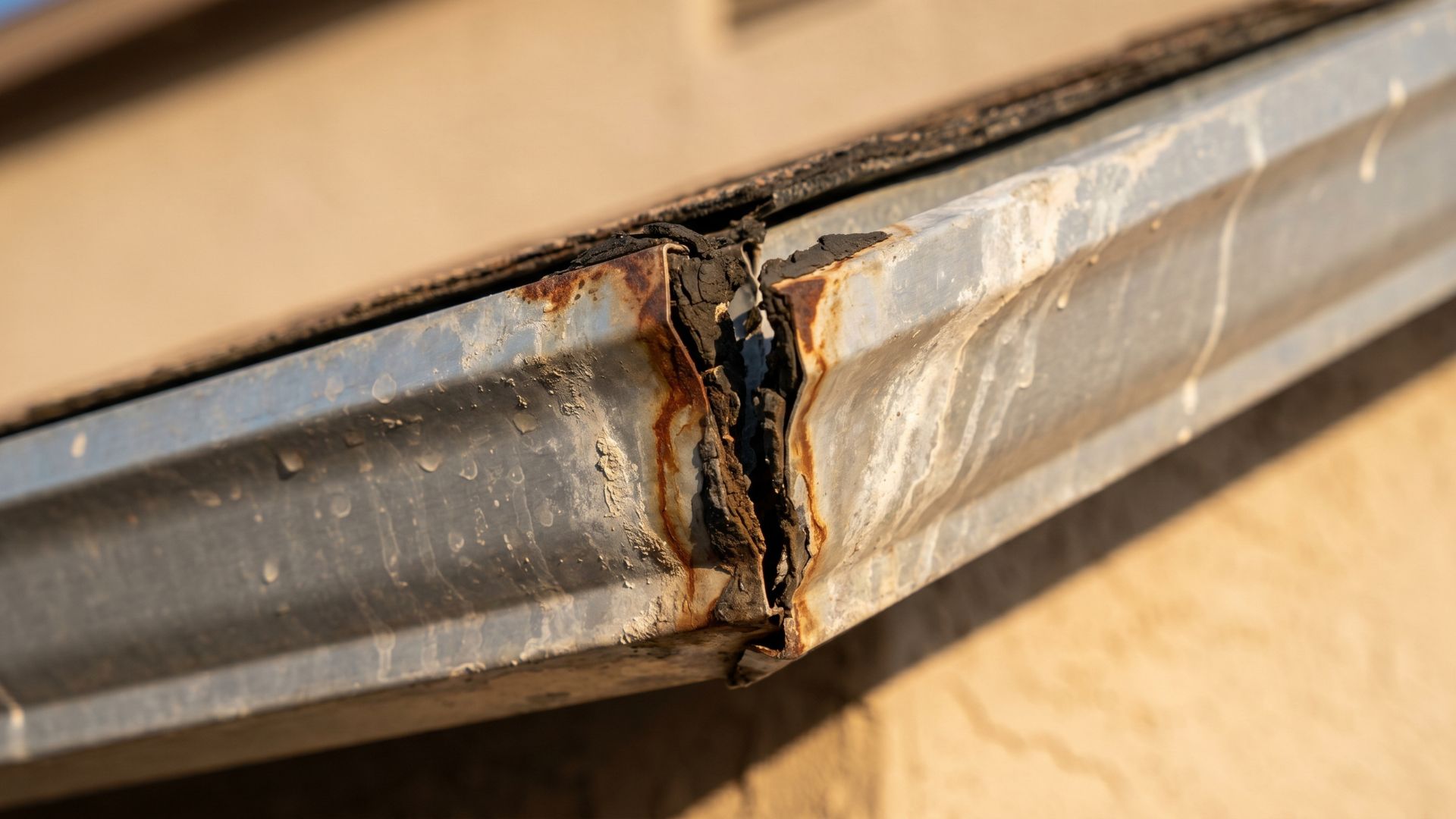
Gutter systems are only as strong as their joints. Miter joints at corners and downspout outlet connections are the most common failure points in Phoenix gutter systems. The extreme temperature fluctuations cause sealant to become brittle and crack. Silicone-based sealants, while flexible, degrade under UV exposure within two to three years in Arizona’s climate. When you observe a visible gap at a corner miter or water dripping from a downspout connection during dry weather, the joint has failed.
Repairing separated joints requires more than applying new sealant. The joint must be cleaned of old sealant residue, mechanically fastened with pop rivets or screws, and then sealed with a polyurethane-based product rated for high-UV environments. As Thomas Redhawk, owner of Redhawk Rain Systems in Scottsdale, advises: “We use a two-step process on Phoenix gutter joints—mechanical fastening for structural integrity, followed by a UV-stable sealant. Single-step sealant-only repairs fail within one monsoon season. The thermal movement is simply too aggressive for a chemical bond alone.”
 5. Pooling Water Near the Foundation
Standing water or consistently damp soil adjacent to the foundation after rainfall is a gutter repair sign that demands immediate attention. In Phoenix, the expansive clay soils common throughout the Valley are highly reactive to moisture changes. When downspouts discharge water too close to the foundation, the soil expands, exerting lateral pressure against foundation walls. The American Society of Civil Engineers has documented that expansive soil damage accounts for approximately $2.3 billion in annual structural repairs across the southwestern United States.
Proper downspout extensions should carry water at least five feet from the foundation. In Phoenix, where lot sizes can be compact, underground drain lines that daylight at the curb or into landscape swales are preferred. Signs of foundation-level water issues include diagonal cracks in exterior stucco, sticking doors, and separation of exterior concrete flatwork from the foundation stem wall. A gutter repair in this context may involve reconfiguring the entire downspout layout rather than simply patching a leak.
6. Rust, Corrosion, and Pitting on Metal Gutters
While aluminum gutters resist rust, they are not immune to corrosion. Phoenix’s hard water, which contains high levels of calcium and magnesium, leaves mineral deposits on gutter interiors as water evaporates. These deposits create localized galvanic cells that pit the aluminum surface. Steel gutter components—screws, hangers, and end caps—rust aggressively in this environment. Orange staining on gutter exteriors or white, powdery oxidation on aluminum surfaces are clear gutter repair signs.
Corrosion is particularly aggressive at the low points of a gutter run where water stands between rainfall events. The City of Phoenix Water Services Department reports that municipal water hardness averages 12-17 grains per gallon, classifying it as “very hard.” This mineral content, combined with monsoon rainwater acidity from atmospheric dust, creates a corrosive cocktail. Replacement of rusted components with stainless steel or powder-coated alternatives extends system lifespan. In severe cases, a full gutter replacement with copper or high-grade aluminum may be more cost-effective than repeated spot repairs.
7. Landscape Erosion and Mulch Washout
Gutter problems often reveal themselves at ground level first. If you notice mulch displaced from planting beds, eroded soil around foundation plantings, or channels carved into decorative gravel, your gutter system is likely overflowing or discharging improperly. In Phoenix’s xeriscaped yards, decomposed granite and desert stone are particularly susceptible to washout because they lack the binding root systems of turf grass.
This erosion is not just a landscaping nuisance. It alters the grade around your foundation, potentially creating negative slope that directs water toward the structure rather than away from it. The Arizona Registrar of Contractors emphasizes that proper site drainage is a fundamental requirement of residential building codes. Gutter repair in this scenario may involve adding downspouts to handle concentrated flow, installing splash blocks, or regrading the affected landscape area. A comprehensive solution addresses both the gutter system’s capacity and the site’s drainage patterns.
Phoenix-Specific Gutter Challenges
Phoenix presents unique gutter challenges that differ markedly from other regions. The monsoon season, typically running from June 15 through September 30, delivers short-duration, high-intensity rainfall that can overwhelm undersized systems. According to the National Weather Service, Phoenix Sky Harbor International Airport recorded a peak rainfall rate of 3.30 inches in one hour during a 2024 monsoon event. Standard five-inch K-style gutters, common on production homes, may be inadequate for roof sections exceeding 800 square feet under these conditions.
Additionally, Phoenix’s dust storms, or haboobs, deposit fine particulate matter on roofs that washes into gutters during the first rain. This sediment load can clog downspouts within minutes. Gutter guards and screens are popular solutions, but they require careful selection. Fine-mesh guards can become clogged with dust themselves, while larger-aperture products allow debris through. A professional evaluation considers roof pitch, surrounding vegetation, and exposure to open desert to recommend the appropriate debris mitigation strategy.
Comparing Gutter Repair vs. Replacement
When gutter repair signs accumulate, homeowners face a decision between targeted repairs and full replacement. The following table outlines16 key considerations for Phoenix properties:
| Factor | Repair | Replacement |
|---|---|---|
| Cost Range (2026 Phoenix) | $180–$650 | $1,800–$4,200 |
| Lifespan Extension | 2–5 years | 20–30 years (aluminum) |
| Seamless Upgrade Option | Not applicable | Available; reduces leak points |
| Fascia Repair Integration | Limited; may require later work | Full access for fascia replacement |
| Warranty | Typically 1 year on labor | 10–20 years on materials |
| Disruption Duration | 2–4 hours | 1–2 days |
As a rule of thumb, if repair costs exceed 50% of replacement cost, or if the system is over 15 years old, replacement offers better long-term value. Seamless aluminum gutters, fabricated on-site with a roll-forming machine, eliminate the miter joint failures that plague sectional systems. For Phoenix homes, this upgrade significantly reduces leak potential during monsoon downpours.
Step-by-Step: How to Inspect Your Gutters for Repair Signs
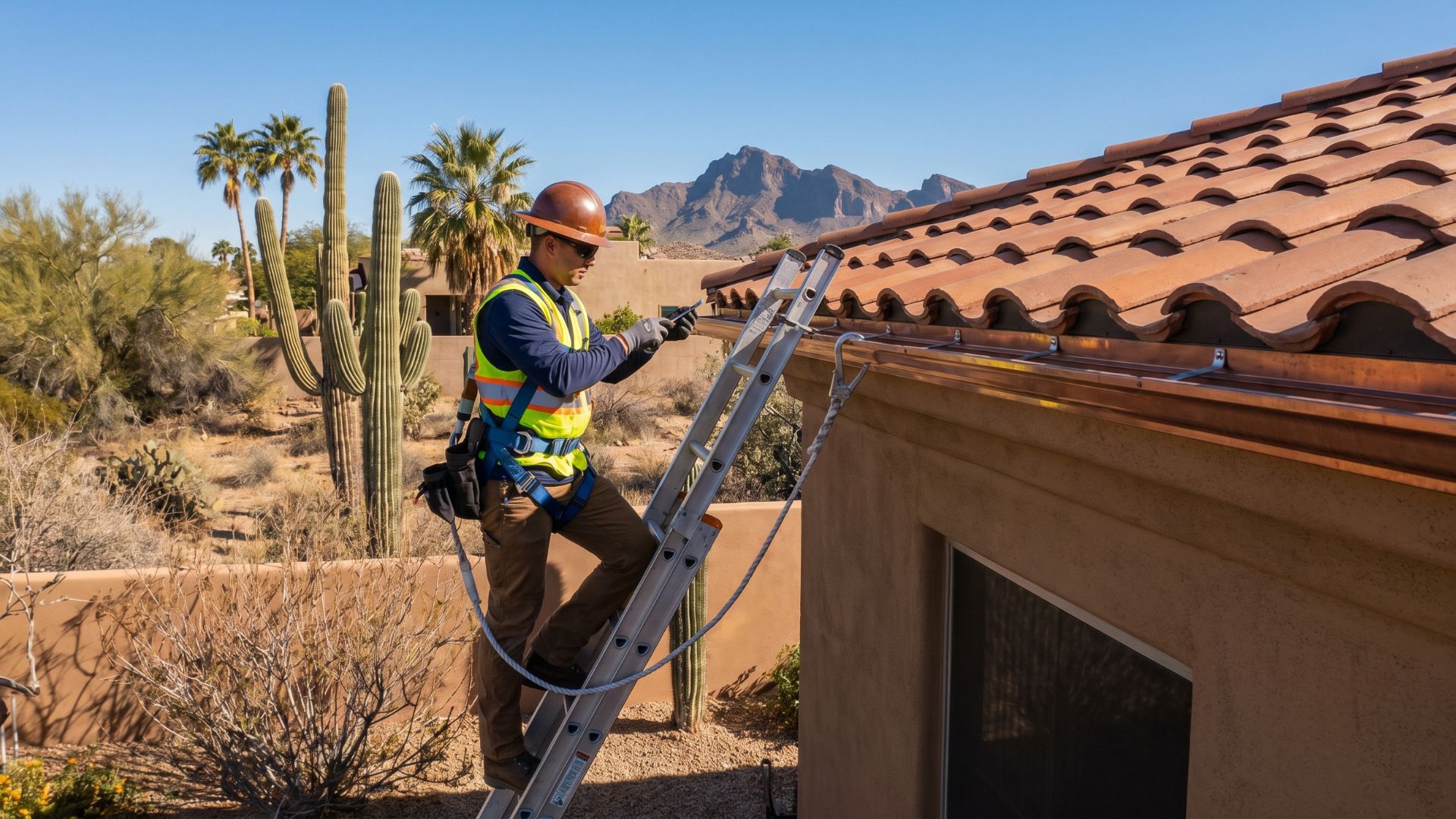
Conducting a thorough gutter inspection twice yearly—in May before monsoon season and in October after it ends—identifies repair signs early. Follow this process:
- Safety First: Use a sturdy extension ladder with a stabilizer bar. Never lean the ladder directly against the gutter. Have a spotter hold the base on uneven desert landscaping.
- Visual Sweep from Ground: Walk the perimeter and look for sagging sections, visible gaps, and water stains on walls. Use binoculars for two-story homes.
- Check Fastener Integrity: At ladder height, gently lift the gutter. Any vertical movement indicates loose hangers. Inspect screw heads for rust.
- Examine Joints and Seams: Look for dried, cracked sealant at miters and downspout connections. Probe with a plastic putty knife—if sealant flakes off, it has failed.
- Clear Debris and Assess Sediment: Remove leaves, dust, and granules. Note the volume and type of sediment. Heavy granule deposits warrant a roof inspection.
- Test Water Flow: Using a garden hose, run water into the gutter at its highest point. Observe flow speed and check for overflow at any section. Verify downspouts discharge freely.
- Inspect Downspout Extensions: Ensure water exits at least five feet from the foundation. Check for crushed or disconnected extension pipes.
- Document Findings: Photograph any damage. These images are valuable for contractor estimates and insurance documentation if storm damage is involved.
 Common DIY Mistakes That Worsen Gutter Damage
Well-intentioned homeowners often exacerbate gutter repair signs through improper DIY fixes. Understanding these pitfalls prevents costly secondary damage.
- Using Interior-Grade Sealant: Bathroom caulk and general-purpose silicone degrade within months under Phoenix UV exposure. Only exterior-grade polyurethane or specialized gutter sealant should be used.
- Over-tightening Fasteners: Driving lag screws too deeply into compromised fascia splits the wood, destroying the anchoring point. If the screw spins without resistance, the fascia requires repair before reattachment.
- Ignoring Pitch Adjustments: Reattaching a sagging gutter without correcting the slope ensures future failure. Gutters require a minimum pitch of one-quarter inch per ten feet of run toward the downspout.
- Patching Holes with Tape: Asphalt flashing tape and duct tape are temporary measures that fail when gutter temperatures exceed 140°F. Proper repair involves cutting out the corroded section and splicing in a new piece with rivets and sealant.
- Painting Over Rust: Without removing rust to bare metal and applying a rust-converting primer, paint simply encapsulates active corrosion. The rust continues to spread beneath the coating.
When to Call a Licensed Phoenix Gutter Contractor
Certain gutter repair signs indicate16 conditions beyond DIY capability. The Arizona Registrar of Contractors requires a C-42 Roofing license for gutter installation and repair when the work involves roof edge modifications. Call a licensed professional when:
- Fascia boards show signs of rot or insect damage requiring carpentry work.
- Multiple gutter sections have separated, indicating systemic fastener failure.
- Downspouts require reconfiguration to address foundation drainage issues.
- Seamless gutter replacement is desired for long-term leak prevention.
- Work involves second-story gutters requiring fall protection equipment.
- Electrical service drops are near the gutter work area, creating shock hazards.
As Dr. Elena Vasquez, a building science researcher at Arizona State University’s Del E. Webb School of Construction, notes: “Phoenix homeowners often underestimate the interaction between gutter systems and the building envelope. A gutter that appears to need simple reattachment may actually be revealing a moisture management failure that extends into the wall assembly. Professional assessment with moisture meters and thermal imaging provides a complete picture that visual inspection alone cannot.”
Preventative Maintenance Schedule for Phoenix Gutters
Proactive maintenance reduces the frequency and severity of gutter repair signs. The following schedule is calibrated for Phoenix’s climate patterns:
- May (Pre-Monsoon): Full inspection, debris removal, sealant check, downspout flush. Verify all hangers are secure. Apply UV-protectant to sealant beads.
- July (Mid-Monsoon): Quick visual check after major dust storms. Clear any accumulated debris from downspout strainers.
- October (Post-Monsoon): Comprehensive inspection. Check for storm damage, granule accumulation, and any new leaks. Clean gutters thoroughly before winter.
- February (Pre-Spring): Inspect for winter storm damage. Check for bird nests or rodent activity in downspouts. Verify downspout extensions remain in place.
According to data from the Insurance Institute for Business & Home Safety, homes with documented biannual gutter maintenance programs experience 62% fewer water damage claims than those without. In Phoenix’s climate, this translates to significant savings given the average water damage claim exceeds $11,000.
Frequently Asked Questions
How often should Phoenix gutters be cleaned?
Phoenix gutters require cleaning at minimum twice annually—once in May before monsoon season and once in October after the storms conclude. Homes near open desert or with overhanging trees may need quarterly cleaning to manage dust and debris accumulation. Neglecting this schedule leads to clogs that cause overflow and foundation damage.
Can monsoon rains really destroy my gutters in one season?
Yes. Monsoon microbursts can deliver rainfall rates exceeding three inches per hour. If gutters are already compromised—loose fasteners, partial clogs, or deteriorated sealant—a single intense storm can cause complete section failure, pulling gutters away from the fascia and flooding the foundation. Pre-monsoon inspection is essential.
What is the average cost of gutter repair in Phoenix in 2026?
Minor repairs such as sealing leaks or reattaching loose sections typically range from $180 to $350. More extensive work, including downspout replacement or fascia repair, averages $400 to $650. Full seamless gutter replacement for an average Phoenix home costs between $1,800 and $4,200 depending on linear footage and material grade.
Are seamless gutters worth the investment in Arizona?
Seamless gutters are highly recommended for Phoenix homes. Fabricated on-site from a single coil of aluminum, they eliminate the miter joints and seams that are the most common leak points in our thermal-cycling climate. The absence of joints reduces failure points by approximately 70% compared to sectional systems, according to manufacturer data.
Do gutter guards work in dusty Phoenix conditions?
Gutter guards require careful selection for Phoenix’s environment. Fine-mesh guards can clog with haboob dust, while open-style guards allow debris through. Micro-mesh stainless steel guards with a 50-micron aperture offer the best balance, blocking granule-sized particles while allowing water to pass. Professional installation ensures proper slope for debris shedding.
How do I know if my fascia board is rotted behind the gutter?
Signs of fascia rot include visible paint bubbling on the fascia, soft spots when probed with a screwdriver, and gutters that pull away despite new fasteners. Water stains on the soffit underside also indicate fascia moisture problems. A professional can use a moisture meter to quantify the extent of damage without removing the gutter.
Is gutter repair covered by homeowners insurance in Arizona?
Gutter damage caused by sudden events—wind-driven debris during a monsoon, falling tree limbs, or hail—is typically covered by homeowners insurance. Gradual deterioration from age, lack of maintenance, or UV damage is not covered. Document all damage with photographs and consult your policy’s specific terms regarding roof and gutter coverage.
Conclusion
Recognizing gutter repair signs in Phoenix before monsoon season arrives is the most cost-effective strategy for protecting your home. The seven critical indicators—sagging, granule accumulation, wall stains, joint separation, foundation pooling, corrosion, and landscape erosion—provide an early warning system that prevents structural damage averaging thousands of dollars. Phoenix’s unique combination of UV intensity, thermal cycling, and monsoon rainfall demands a proactive maintenance approach that differs from other regions. Biannual inspections, prompt professional repairs, and consideration of seamless upgrades form the foundation of a sound gutter management strategy. If you have observed any of the signs discussed in this guide, do not wait for the next storm to test your system’s limits. Contact our Phoenix gutter specialists today for a comprehensive assessment and repair estimate tailored to your home’s specific needs.
References
- National Association of Home Builders – Gutter installation standards and climate-specific fastening guidelines.
- Cool Roof Rating Council – Research on rooftop surface temperatures in desert climates.
- International Association of Certified Home Inspectors – Efflorescence and moisture intrusion inspection protocols.
- American Society of Civil Engineers – Expansive soil damage data for the southwestern United States.
- City of Phoenix Water Services Department – Municipal water hardness data and mineral content reports.
- Arizona Registrar of Contractors – Licensing requirements for gutter and roofing contractors.
- National Weather Service – Phoenix monsoon rainfall intensity records and climate data.
- Insurance Institute for Business & Home Safety – Maintenance program effectiveness and water damage claim statistics.